

Multi-Car Accidents Can Involve More Than One Insurance Policy. Here’s What You Need to Know.
When a multi-car accident happens, the scene can go from calm to chaotic in a split second. Multiple vehicles are involved, people are injured, and everyone is pointing fingers at someone else. Sorting out whose insurance pays, how much, and in what order is rarely straightforward.
At The Weinstein Firm, we have helped countless accident victims across Georgia cut through the confusion and recover the compensation they deserved. Working with an experienced Atlanta car accident attorney from our team means you have someone in your corner who knows how to identify every at-fault driver, coordinate claims across multiple insurance companies, and fight for every dollar you are owed.
What Is a Multi-Car Accident?
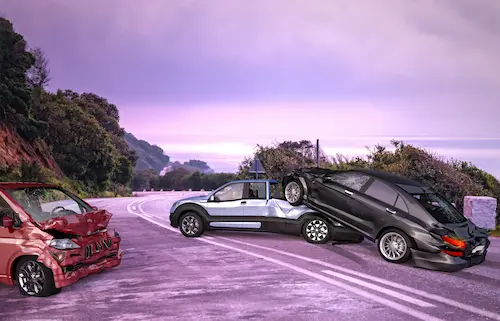
Multi-car accidents involve more than two vehicles and often cause serious injuries, major property damage, and complicated insurance claims.
Defining Multi-Car or Multi-Vehicle Collisions
A multi-car accident typically involves three or more vehicles in a single crash. These events are also called multi-vehicle collisions, pileups, or chain reaction crashes. They happen on interstate highways, city intersections, and rural roads across Georgia and the rest of the country.
Common Settings for Multi-Vehicle Crashes
Multi-car crashes often occur on eastbound, westbound, and southbound lanes of busy interstates. Intersections are another common site, especially when a driver runs a red light. City streets and rural highways also see their share of multi-vehicle collisions.
Real-World Scenarios
A speeding driver can rear-end a stopped car in the left lane, pushing it into other vehicles and starting a chain reaction. A truck driver who loses control in dense fog, heavy rain, or standing water can trigger a multi-car pileup within seconds. An intersection wreck caused by a red light violation can send one vehicle into oncoming traffic, pulling several more cars into the collision.
Why Insurance Responsibility Matters
Multiple people can suffer serious or life-threatening injuries in a multi-vehicle crash. Damages from a pileup can exceed what a single insurance policy covers, especially when many drivers, passengers, and pedestrians are involved.
The Insurance Framework in Multi-Car Accidents
Understanding how insurance works in a multi-car accident helps you know what to expect and where your compensation may come from.
Fault vs. No-Fault States
In at-fault states like Georgia, the driver who caused the accident is financially responsible for injuries and property damage. In no-fault states, each injured person first files a claim through their own Personal Injury Protection (PIP) coverage. Serious injuries in no-fault states may still allow victims to file a claim against the at-fault driver.
Key Insurance Coverages in Multi-Vehicle Crashes
Several types of coverage can come into play after a multi-car accident:
- Liability Insurance: Pays for injuries and property damage to others when you are at fault.
- PIP/MedPay: Covers medical bills regardless of who caused the crash, depending on your state.
- Uninsured/Underinsured Motorist Coverage (UM/UIM): Pays when the at-fault driver has little or no insurance.
- Collision Coverage: Pays for damage to your own vehicle, minus your deductible.
Which Policies Pay and In What Order
The real question after a multi-car accident is not just whose insurance pays, but which policies pay, in what order, and up to what limits. A single crash can trigger claims across multiple policies from multiple drivers. Knowing the sequence helps victims recover compensation faster and more completely.
Whose Insurance Pays in a Multi-Car Accident?
In Georgia, the driver who caused the accident is usually the one whose insurance pays for the damages. This includes things like medical bills, car repairs, and other costs from the crash.
But when more than two cars are involved, figuring out who’s at fault — and who pays — gets more complicated.
How It Works:
- Georgia is an “at-fault” state. This means the driver who caused the crash (or caused most of it) is financially responsible.
- That driver’s liability insurance is supposed to cover:
- Medical expenses for injured people
- Damage to other vehicles
- Other accident-related costs
What If More Than One Driver Shares Fault?
- Georgia uses a rule called modified comparative negligence.
- That means:
- If you’re less than 50% at fault, you can still recover money, but your payout will be reduced based on your share of the blame.
- If you’re more than 50% at fault, you can’t collect any compensation from others.
Example
Let’s say three cars are in a pile-up. Investigators decide:
- Driver A is 70% at fault,
- Driver B is 20% at fault, and
- Driver C is 10% at fault.
Each driver’s insurance would pay for a portion of the damages based on those percentages.
What Makes These Cases Tricky?
Each driver’s insurance company may try to avoid paying by blaming the others. This can lead to delays, disagreements, and lowball settlement offers.
That’s why having an experienced car accident lawyer on your side is so important. They can help figure out who’s responsible and fight for the full compensation you’re owed.
How a Multi-Car Accident Claim Works
Filing a car accident claim after a crash with multiple drivers can be more complicated than in a two-car collision. Here’s how the process typically works.
Filing Claims
You may need to file claims with multiple insurance companies, depending on the number of drivers involved and the determination of fault. Each insurance company will conduct its investigation. They may review police reports and interview witnesses.
Insurance adjusters from each insurance company will assess the damages and determine how much compensation the injured parties should receive. It’s essential to be cautious when speaking with insurance company representatives, as their goal is to minimize payouts.
Negotiating Settlements
Negotiating a fair settlement after a multi-car accident can be challenging. An experienced car accident lawyer will fight to ensure that you receive the compensation you deserve
Legal Action
If insurance won’t offer a fair settlement, an experienced attorney can file a personal injury claim and represent you in court. In some cases, you may be able to pursue personal injury lawsuits against multiple parties. Legal representation in a multi-car accident case is essential to secure the compensation you deserve.
What If Auto Insurance Policies Max Out?
Georgia law requires that drivers maintain auto insurance. The minimum requirements include $25,000 for bodily injury per person, $50,000 for total bodily injury per accident, and $25,000 for property damage.
In multi-car pile-ups, damages can easily exceed the insurance policy limits. Having uninsured and underinsured motorist coverage can help in this scenario. This type of insurance kicks in if other drivers don’t have enough insurance coverage or are uninsured.
What If No One Is to Blame?
Occasionally, car accidents may occur due to factors outside the drivers’ control. For example, adverse weather conditions or sudden mechanical failures can lead to crashes without any driver being at fault.
When no one is at fault, each driver may need to turn to their own insurance policy to pay for damages and injuries sustained in the accident. Drivers may rely on personal injury protection (PIP) or medical payments (MedPay) coverage for medical bills and other expenses. Additionally, collision coverage may be used to cover vehicle damage.

How Fault Is Determined in a Multi-Car Accident
Fault determines which driver or drivers are financially responsible for injuries and damages after a multi-vehicle collision.
Basic Principles of Fault
The driver who starts the chain reaction usually carries the most responsibility. Shared fault is common in multi-car accidents, especially when multiple drivers were speeding, following too closely, or ignoring dangerous road conditions. Insurance companies and attorneys investigate each vehicle’s role in the crash before assigning blame.
Evidence Used to Determine Fault
Investigators rely on several types of evidence to piece together what happened:
- Police reports: Georgia State Patrol and local police document road conditions, weather, vehicle positions, and the point of initial impact.
- Physical evidence: Skid marks, debris, and damage patterns show how vehicles moved during the crash.
- Witness statements: Accounts from other motorists, pedestrians, and bystanders help confirm the sequence of events.
- Video footage: Dashcams, traffic cameras, and surveillance recordings can show the crash in real time.
- Data and records: Vehicle black boxes, phone records, and toxicology reports can reveal driver behavior before impact.
Key Investigative Factors
Investigators look at who started the chain reaction and whether each driver maintained a safe following distance, given the speed and road conditions. Driver distraction, impairment, and reckless maneuvers all factor into fault decisions. How each driver attempted to avoid hitting other vehicles also plays a role.
Real Examples of Fault in Multi-Car Crashes
A truck driver speeding through dense fog who rear-ends slowed traffic can be held primarily responsible for a deadly multi-vehicle pileup. A driver who runs a red light and pushes one vehicle into the oncoming lanes, triggering a multi-car wreck, will likely bear the greatest share of fault.
Single-Fault vs. Shared-Fault in Multi-Vehicle Crashes
In a multi-car accident, one driver may be fully responsible, or several drivers may share blame depending on how the crash unfolded.
When One Driver Is Clearly at Fault
In a rear-end chain reaction, the last car in line is usually the most at fault. That driver’s liability insurance pays for injuries and property damage to others, up to the policy limits. Middle drivers can still share fault if they were speeding, following too closely, or had faulty equipment on their vehicle.
When Multiple Drivers Share Fault
Many states apply comparative fault rules, meaning each driver is assigned a percentage of responsibility for the crash. Insurance companies pay damages in proportion to each driver’s share of fault. Some states reduce or block recovery entirely if a driver is found 50% or more at fault. In a multi-vehicle collision during heavy rain, fault may be divided among several drivers based on speed, following distance, and driver behavior.
How Comparative Negligence Affects Your Claim
If you are partly at fault, your compensation may be reduced by your percentage of blame. For example, if you are found 20% at fault, you can only recover 80% of your total damages. Georgia follows modified comparative negligence, which bars recovery if you are 50% or more responsible for the accident.
No-Fault State Variations
In no-fault states, PIP coverage pays first regardless of who caused the crash. Drivers with serious injuries may still file claims against at-fault drivers, with comparative fault rules applied to any damages recovered beyond PIP benefits.
Step-by-Step: Whose Insurance Pays and In What Order
After a multi-car accident, compensation does not come from a single source but moves through a specific sequence of insurance coverage depending on fault, policy limits, and state law.
Step 1: Immediate Medical Coverage
PIP or MedPay coverage pays for initial medical expenses regardless of fault, if available in your state. Health insurance may also step in to cover treatment costs while fault is still being determined. Getting medical attention quickly at a local hospital protects both your health and your injury claim.
Step 2: At-Fault Driver’s Liability Insurance
In at-fault states like Georgia, the at-fault driver’s liability insurance is the primary source of compensation for other people’s injuries and property damage. This coverage pays out up to the policy limits set by the at-fault driver’s plan. If the at-fault driver’s limits are low, victims may need to look to additional sources.
Step 3: Multiple At-Fault Drivers
When more than one driver shares fault, claims can be filed against each driver’s insurance separately. Each insurer pays up to its own policy limits in proportion to its driver’s assigned percentage of fault. Victims in a multi-vehicle pileup may deal with several insurance companies at the same time.
Step 4: Policy Limits and Exhaustion
Multi-car pileups can quickly exhaust one driver’s policy limits, especially when several people suffer serious or life-threatening injuries. UM/UIM coverage becomes important when the at-fault driver’s insurance falls short of covering total damages. Pursuing a driver’s personal assets is possible but is rarely a fast or reliable path to full compensation.
Step 5: Collision Coverage for Vehicle Damage
Drivers can use their own collision coverage to pay for vehicle repairs regardless of fault, minus their deductible. Their insurer may then seek reimbursement from the at-fault driver’s insurance company through a process called subrogation. This option helps victims get their vehicles repaired faster without waiting for the fault to be fully settled.
Step 6: No-Fault State Differences
In no-fault states, PIP pays first for medical expenses, no matter who caused the crash. Drivers with severe injuries may still file claims against at-fault drivers once their PIP benefits are exhausted. Comparative fault rules apply to any damages recovered beyond what PIP covers.
Hurt in a Multi-Car Accident? The Weinstein Firm Is Ready to Help!
If you or a loved one was injured in a multi-car accident, do not face the insurance companies alone. Our team at The Weinstein Firm knows how these cases work, who is responsible, and how to build a strong claim on your behalf. We offer a free case review so you can get answers without any upfront cost.
Contact us at 770-HELP-NOW for a free consultation today!


